Habitus Magazine features Red Hill Halfway House
A Brisbane architect rewrites the narrative of an old Queenslander on a small, steep block with a design that relishes every gradient.
Credit must go to the early designers and builders of Queensland’s quintessential offering to the architectural archives, particularly in its capital, Brisbane, where old city suburbs rise and dip haphazardly on topographically tricky terrain. The archetypal ‘Queenslander’ is essentially a timber and tin box on stumps. It’s an enduring design and dream build on flat ground – but a lesson in ingenuity on a block like this one, where only the entry meets the earth. Securing one of these original inner city centenarians could be considered equal parts privilege and curse. And those tasked with adapting them for modern life without destroying their charms might feel the same way.
Owners Matthew and Caroline, a pair of physicians who work in nearby city hospitals, were drawn to its lofty position and expansive views of the Brisbane skyline to the south. Less appealing was the state of the dilapidated relic when they bought it five years ago. “It had what appeared to be a homemade downstairs area that obviously needed to have something done to it,” says Matthew. “And it was clear that the backyard was not being used at all.”
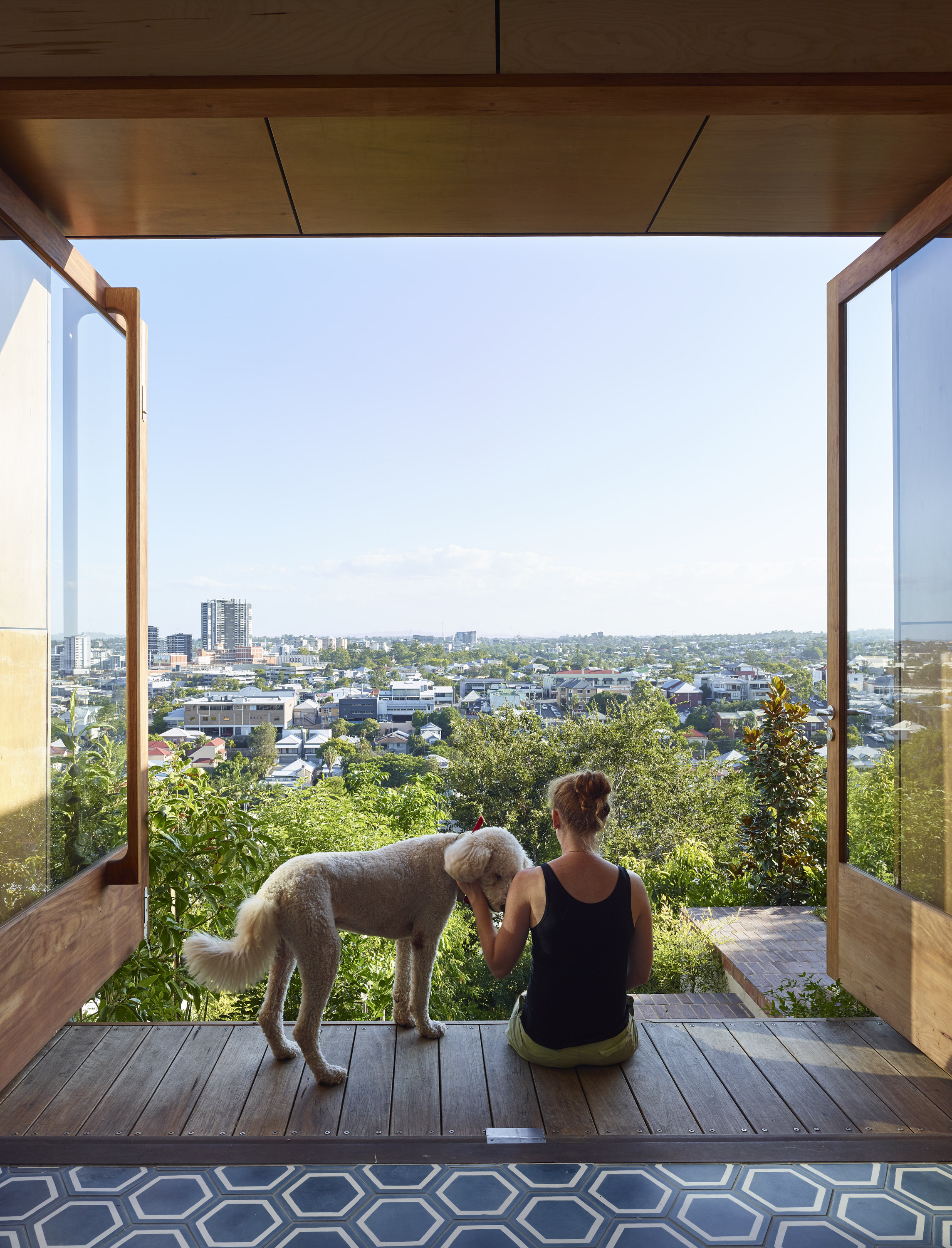
A year in, they began a working relationship with architect Matt Kennedy, principal of Arcke, a boutique firm familiar with the quirks and restrictions of old Queenslanders, to transform the former share house into a family home that made the most of its lot. “The original Queenslander perched precariously on a ridge and lacked any real connection to the steep ground at the rear of the site,” says Matt. “All of our renovation designs start with an in-depth understanding of the existing site and terrain together with a thorough comprehension of the structure and history of the original home. From there we are able to determine core elements to be retained and restored. There is an honesty and integrity to the way Queenslanders are built and we always try to work with and complement this in our architectural response,” he says.
His clients had made it clear they didn’t want a conventional upstairs/downstairs floorplan. “Essentially all the living gets done on one level and the other level becomes just a dormitory,” says Matthew. “I was cognitive of the fact that if the kitchen was on the top level no one would go downstairs and into the backyard. And it might seem contrived putting it on a lower level, away from the obvious entrance of the house.”
Read the full story here. Images by Scott Burrows.